Revenue Sharing vs. Monthly Retainer vs. Internal Recruiter: Which Model Wins?
Your recruiter just told you it’ll take another 6 weeks to fill that engineering role.
Meanwhile, the contingent agency you called wants 25% of the first-year salary. That’s $30,000 for one hire.
And your CFO keeps asking why you don’t just hire a full-time recruiter if you’re filling 20 roles this year.
Three options. Three different cost structures. And nobody’s actually showing you the math on which one makes sense at your hiring volume.
Here’s the breakdown CEOs actually need.
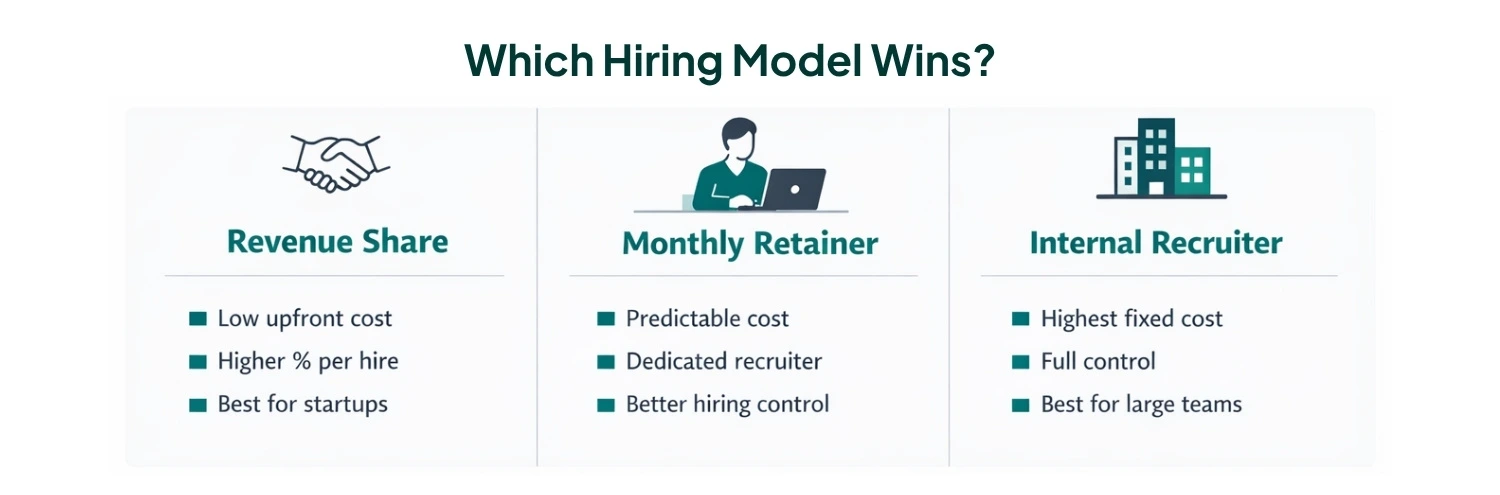
Model 1: Revenue Sharing (Contingency)
How it works:
Pay only when you hire. Industry standard runs 15-30% of the candidate’s first-year salary. Entry-level roles typically cost 10-15%. Mid-level and senior positions run 20-25%. Executive and specialized roles hit 25-30%.
Sporadic hiring under 10 roles annually. Budget-constrained startups with no upfront cash flow. Companies that can’t commit to monthly fixed costs.
When it loses:
High-volume hiring where fees multiply fast. Predictable monthly hiring needs where dedicated resources cost less. Situations where multiple contingent recruiters compete on the same roles, creating quality and coordination issues.
Model 2: Monthly Retainer (Dedicated Resource)
How it works:
Fixed monthly fee buys dedicated recruiting capacity. Typical model: $2,000 per month equals $24,000 annually. This includes 160 hours monthly and handles unlimited roles within that capacity.
Real cost examples:
10 hires per year = $2,400 per hire
20 hires per year = $1,200 per hire
50 hires per year = $480 per hire
The more you hire, the lower your per-hire cost drops.
When it wins:
Consistent hiring between 15-50 roles annually. Predictable budget planning where you know monthly costs. Need for dedicated focus rather than competing with other clients for recruiter attention.
When it loses:
Hiring under 10 roles yearly makes the math unfavorable. Extreme seasonality where you hire heavily for 3 months then go silent for 9 months. Can’t commit to a 12-month engagement.
Model 3: Internal Recruiter
Fully loaded annual cost
$137,383
One internal recruiter · verified industry averages
vs. monthly retainer
Save $113K+
every single year
Monthly retainer equivalent: $24,000/year · Outsure Global
How it works:
Hire a full-time recruiter on your payroll. Based on verified industry data, a fully-loaded internal recruiter costs $137,383 annually. This includes base salary of $73,000, payroll taxes at $6,523, benefits at $23,360, recruiting tools at $15,000, and overhead costs of $19,500.
Real cost examples:
10 hires per year = $13,738 per hire
20 hires per year = $6,869 per hire
50 hires per year = $2,748 per hire
When it wins:
Hiring 40+ roles annually where the fixed cost spreads favorably. Need for strategic recruiting function beyond just filling roles. Building an employer brand is a competitive priority. High-touch executive recruiting requires deep company knowledge.
When it loses:
Hiring under 30 roles yearly makes cost per hire too expensive. Bench risk during slow hiring periods when you’re paying $137K for minimal output. Can’t afford the fixed cost commitment.
Monthly retainer wins at every volume from 10–50 hires/year · Outsure Global
At 10 hires per year (average $80K salary):
Revenue sharing at 20%: $160,000 total ($16,000 per hire)
Monthly retainer: $24,000 total ($2,400 per hire)
Internal recruiter: $137,383 total ($13,738 per hire)
Winner: Monthly retainer saves $113K versus internal recruiter and $136K versus revenue sharing.
At 20 hires per year (average $80K salary):
Revenue sharing at 20%: $320,000 total ($16,000 per hire)
Monthly retainer: $24,000 total ($1,200 per hire)
Internal recruiter: $137,383 total ($6,869 per hire)
Winner: Monthly retainer saves $113K versus internal recruiter and $296K versus revenue sharing.
At 50 hires per year (average $80K salary):
Revenue sharing at 20%: $800,000 total ($16,000 per hire)
Monthly retainer: $24,000 total ($480 per hire)
Internal recruiter: $137,383 total ($2,748 per hire)
Winner: Monthly retainer saves $113K versus internal recruiter and $776K versus revenue sharing.
The pattern is clear: monthly retainer wins from 10-50 hires annually. Revenue sharing only makes financial sense under 8 hires yearly. An internal recruiter becomes competitive above 40 hires when you need strategic function beyond pure execution.
Beyond Cost: The Real Decision Factors
But cost isn’t everything. Three other factors matter:
Cash flow timing: Revenue sharing requires payment after the hire, which works better for tight cash flow. A monthly retainer creates predictable expenses. Internal recruiter demands biweekly payroll commitment regardless of hiring activity.
Quality control: Revenue sharing incentivizes speed over fit since recruiters earn nothing until someone accepts an offer. Monthly retainer allows dedicated focus with quality as the priority. An internal recruiter knows your company culture deeply but may lack an external market perspective.
Scalability: Revenue sharing scales infinitely on a pay-per-use model. Monthly retainer limits you to roughly 20 roles per dedicated resource. Internal recruiter caps at 20-25 roles annually per person.
The Hybrid Model Most Companies Actually Use
Internal senior recruiter
Strategy, employer brand, culture fit
$137,000
Annual fixed cost
Revenue sharing
Executive and specialized roles
$75,000
3–5 roles/yr · 20–25% fee
Monthly retainer
Volume roles, unlimited capacity
$24,000
15–30 roles/yr · $2K/mo
Hybrid total
$236K
40–50 hires/year
3 internal recruiters
$411K
+$175K more
All revenue sharing
$640K
+$404K more
Hybrid model$236K
3 internal recruiters$411K
All revenue sharing$640K
Cost per hire: $4,720–$5,900 with hybrid ·
Outsure Global
Smart CEOs don’t pick one model. They stack them based on role type and volume.
Typical hybrid setup for 40-50 annual hires:
Monthly retainer for volume roles (15-30 yearly): $24,000
Revenue sharing for executive and specialized positions (3-5 yearly): $75,000
One internal senior recruiter for strategy and employer branding: $137,000
Total annual cost: $236,000 for 40-50 hires
Cost per hire: $4,720-$5,900
Compare this to hiring three internal recruiters at $411,000 annually or using all revenue sharing at $640,000. The hybrid model wins on both cost and capability.
Run Your Numbers
Your hiring volume determines your optimal model. Under 10 hires annually, revenue sharing makes sense. Between 10-40 hires, monthly retainers win. Above 40 hires, a hybrid combining internal recruiter with monthly retainer delivers the best cost and quality balance.
Calculate your annual hiring plan. Count the roles. Multiply by your average salary. Run the math across all three models.
We use cookies to enhance your browsing experience and analyze website traffic. By clicking Accept All, you consent to our use of cookies as described in our Cookie Policy.
Functional
Always active
Functional cookies are required for the website to operate properly. They enable essential features such as page navigation, security, and form submissions.
Preferences
The technical storage or access is necessary for the legitimate purpose of storing preferences that are not requested by the subscriber or user.
Statistics
The technical storage or access that is used exclusively for statistical purposes.Statistics cookies help us understand how visitors interact with our website by collecting anonymous information. This helps us improve the website and user experience.
Marketing
Marketing cookies may be used to track visitors across websites and display relevant content or advertisements.